All the Times of the Journey
Alice: «How long is forever?»
White Rabbit: «Sometimes, just one second»
Lewis Carroll — Alice in Wonderland
Time is one of those things that, in our common perception, is among the most elusive and difficult to control. Depending on our mood, it can pass incredibly fast or, on the contrary, unbearably slow. And it hardly matters whether we are checking our watch because, even then, the speed of time will depend on the emotions we are experiencing, which will inevitably influence its flow—at least on a perceptual level.
We could therefore say that the perception of passing time is a composite of several elements that seem discordant at first glance: the continuous and unchanging flow of seconds; a “perceptual” time that shifts according to our moods; and a time that somehow “emanates” from the things around us, engaging us in a kind of silent dialogue.
Of course, when we talk about time and the different ways we perceive it, we also talk about space, because the two concepts are intrinsically linked and mutually dependent.
In Lek M. Gjeloshi’s works, we can sense this subtle space-time shift that the artwork presents. It is as if the artist slightly manipulates the passage of time to create provisional spaces where we can experience this detachment from reality.
-01 Suspended Time
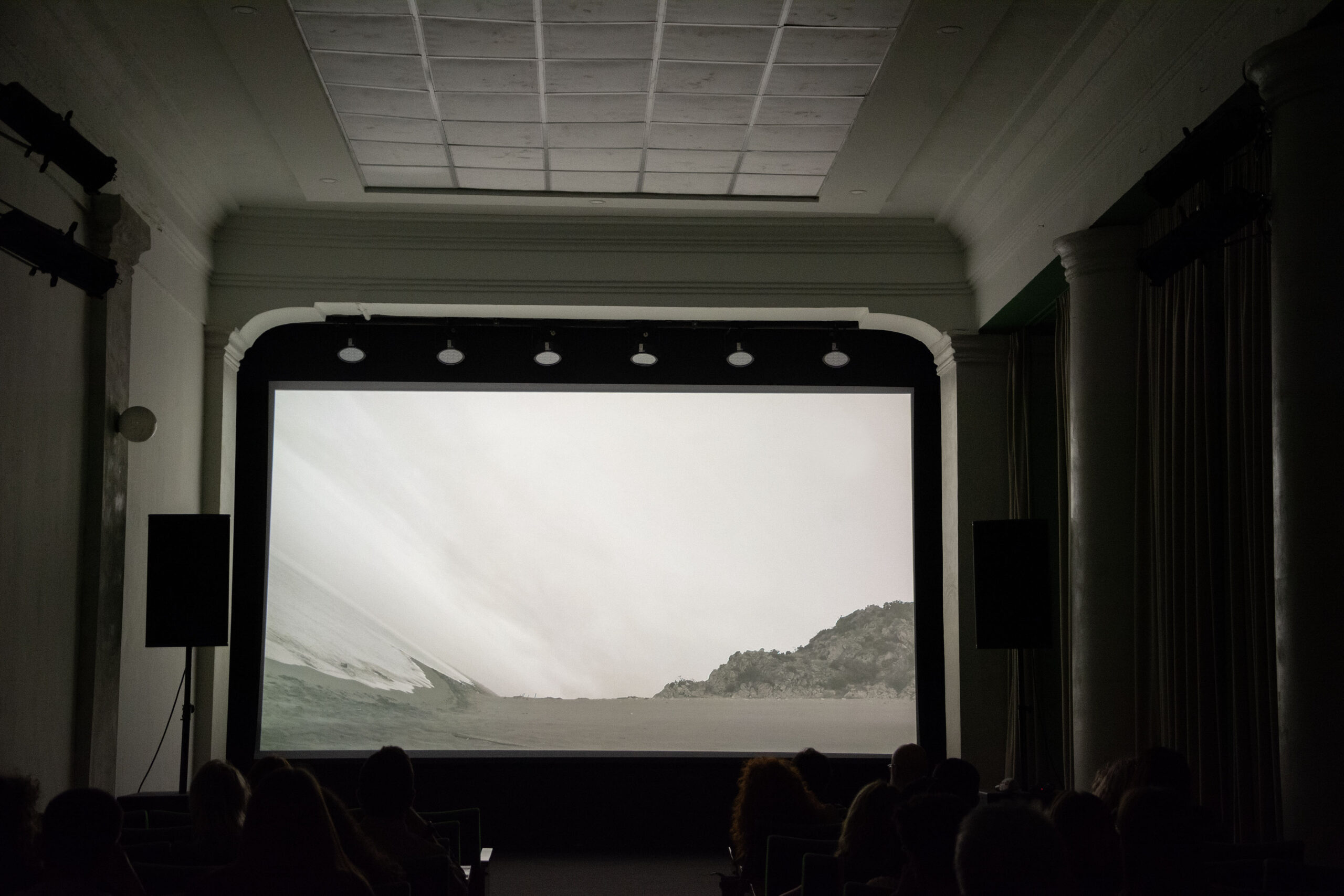
“Untitled #2” (single-channel video) is set in a coastal location in northern Albania called “Rana e Hedhun” (Scattered Sand). The technical device used by Lek was to tilt the camera so that it follows the slope of the sand dune. This immediately causes the viewer to lose the spatial references that the eye naturally seeks in a landscape—most notably, the horizon line.
As we watch the video, we see a person in the distance walking toward us and then following the—now horizontal—line of the dune. What contributes to the visual disorientation is the effort the traveler makes to walk along this horizontal line, making us perceive that the line is not horizontal at all. Time no longer flows linearly because space itself is no longer linear. The time of that journey, taken by the traveler, becomes the time it would take to cross a metaphysical, potentially infinite space.
-02 Rhythmic Time
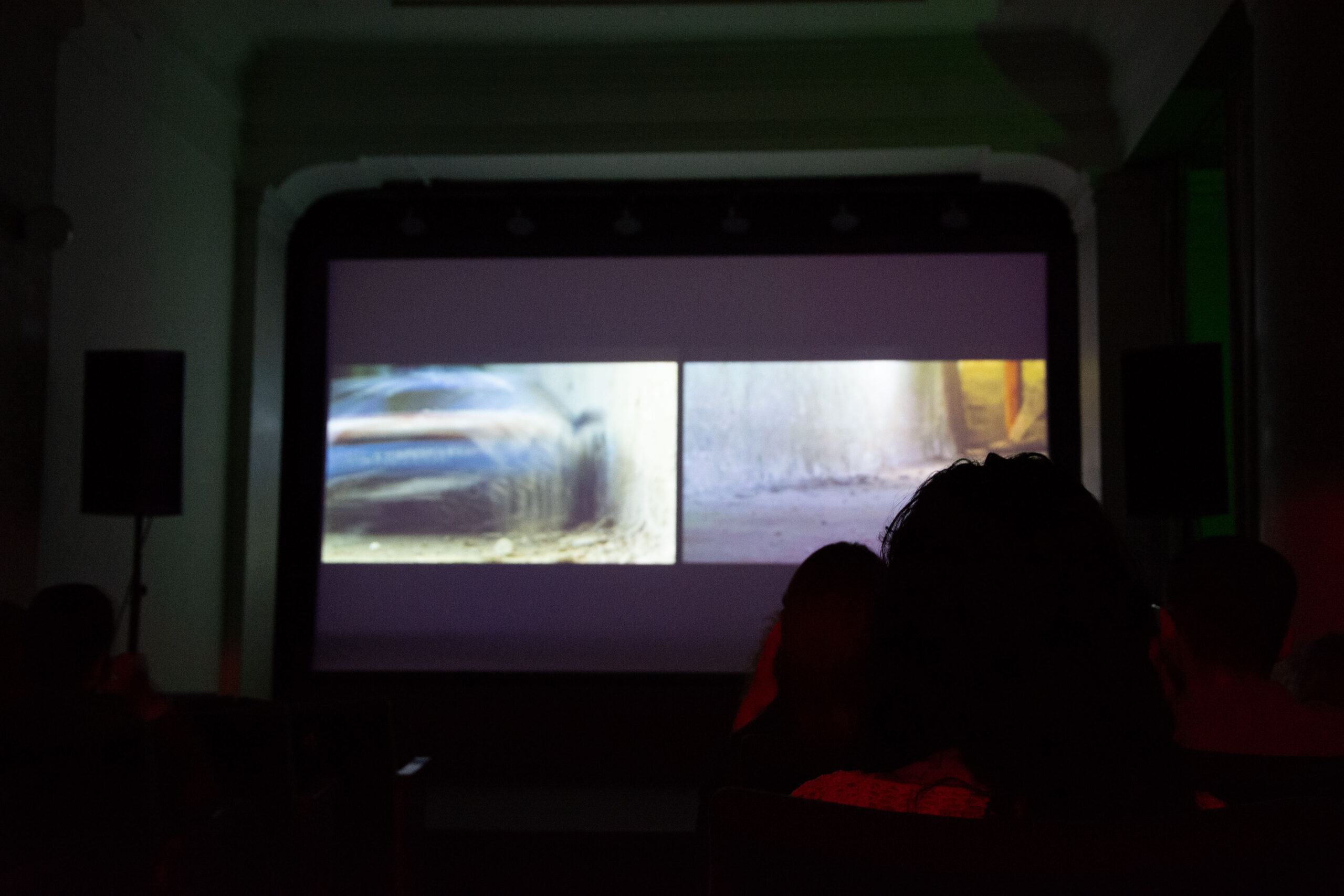
This is a very different sense of time from what we experience in “Huracán”. In this two-channel video, the subject is a 1:14 scale model of the Lamborghini Huracán, a car that the Bologna-based company donated to the Italian State Police for special operations such as emergency response or organ transport.
In the video, our perspective is at the exact level of the model. This choice creates a different perception of space, as Maurice Merleau-Ponty observed, noting that the experience of vision is inseparably linked to that of the entire body:
«It is by lending his body to the world that the artist transforms the world into paintings»[1]
When the model car is turned on, it unexpectedly begins crashing into a wall. The first impact catches us off guard, but as the minutes pass, the crashing sound becomes a rhythmic pulse that accompanies us throughout the viewing. The car’s name carries the aggression of the animal it represents, releasing its force with each collision. There is no longer any surprise—we might even begin to anticipate the moment when the car will break after yet another impact. No escape is offered to us. However, the rhythmic time of the video does not extend infinitely; it has a linear direction and a final purpose—the destruction of the car. And we remain there, watching, powerless, waiting for that fate to unfold in the relentless act of crashing into the wall.
-03 Cyclical Time
A wall also serves as the setting for “In the Visoki Deçani Crucifixion fresco there are no UFOs” (three-channel video). The video takes us on a journey across the surface of a fresco depicting the Crucifixion of Jesus Christ, painted by an anonymous artist. The artwork was created in 1530 within the Serbian Orthodox Monastery of Visoki Deçani, in the town of Deçan, Kosovo. Despite the exquisite craftsmanship of the fresco, what makes this Crucifixion particularly mysterious are the two figures placed to the right and left of Christ. Many historians interpret them as symbolic representations of the sun and the moon, yet they appear oddly alien—strikingly similar to spaceships, as some researchers have suggested. What is fascinating is that the artist uses this mystery to take us on a journey—a journey into the thin surface of painting, transforming it into a dense and profound atmosphere. Once again, our spatial and temporal references are lost. As we travel through this image, we enter a circular, cyclical time, as if we were on an interplanetary voyage.
In these three works, what we experience is a constant sense of displacement, unfolding through spaces and times that never perfectly align, generating an ongoing sense of mystery. A mystery much like our very existence in the universe—floating and spinning wildly according to the laws of gravity. Like a planet oscillating endlessly between perihelion and aphelion, engaged in a mysterious galactic journey.
Stefano Romano
[1] (Merleau-Ponty, Occhio e mente in Il primato della percezione, 1964, p. 123)
Photo documentation of the event: Amarda Rrapo